Don’t Wait Until It’s Too Late

A friend of mine just had a heart attack. It was mild and he’s going to be ok, although it could have been much worse. For the better part of a year we’ve had the ongoing discussion about how he was going to start working out and eating more healthfully. Work and family always demanded too much of him and he could never seem to find time to start a program.

heart-attack

This is such a common situation. I hear it all of the time. But here’s the thing, if you put it off too long and something happens, how much good will you be to your work or your family?

You will hear me say a thousand times that it’s never too late to start. Of course, that’s if you are still around to start. Please think about this. Yes, it is a scare tactic, but more than that, it’s a reality check. Life can be short and we want to have the longest, best quality life we can. Can you afford to put getting healthy off?

“Maybe it is true, that people only care when it’s too late.” – Anon

Do You Have a Dad Bod?

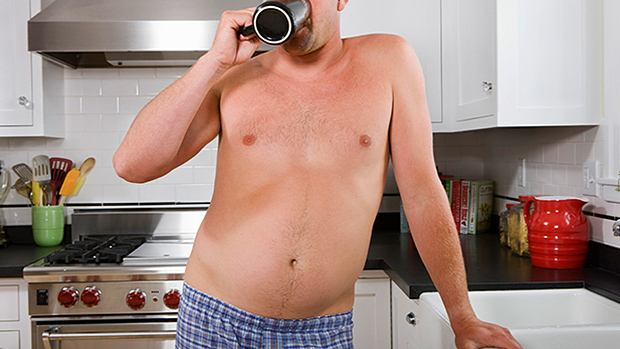
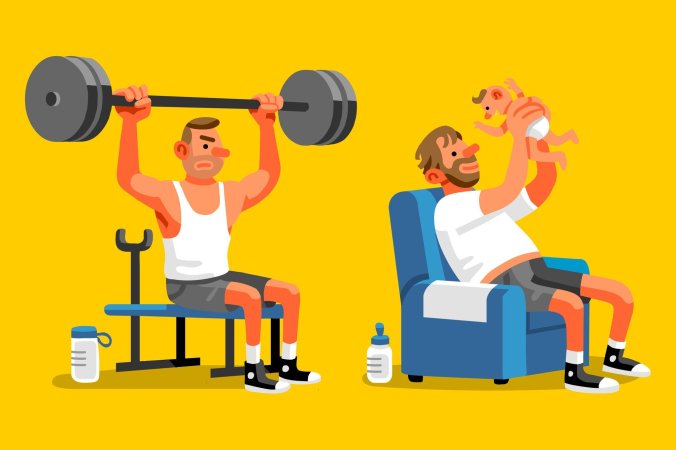
First time I heard the phrase, “dad bod”, I was a little confused. First, I didn’t really know what that meant, me being a dad and all. Second, evidently, many men sporting the dad bod were satisfied with the way they looked. Third, there was a significant number of women that were saying that they preferred a man with a dad bod.

21up-dadbods-superJumboSo, what is a dad bod? In a recent article from the New York Times, Losing the Fight Against ‘Dad Bod’, it is quantified as being 5 – 15 pounds over what might be considered ideal. It’s rounder and maybe includes a slight beer belly. OK, so, in the scheme of things, when roughly 70% of the US population is classified as overweight and 36% considered obese, 5 – 15 pounds doesn’t seem so bad.

I haven’t seen any documented rationale explaining why men might be satisfied with a dad bod, but, taking a guess, I’d say it’s because it’s not so hard to maintain and allows them to enjoy more food and drink than their ripped body toting counterparts.

The-Workout-Cure-for-Dad-Bod

And, yes, women do seem to like the look. This has been surveyed and the overall response as to why they like it, seems to be that men are “less neurotic” about their looks which means more relaxed eating habits and not spending endless hours at the gym. This leaves more time to be spent nurturing the kids, doing things around the house, and taking care of the wives.

Should you be sporting a dad bod? Well, it’s unlikely that 5 – 15 pounds over ideal body weight is going to present a health issue (but, that’s a decision for your doctor to make), so it really comes down to your own perception of how you look. If you are happy with the way you look, rock on. If not, then you need to take the dietary and exercise steps to get leaner.

Big final note: just because you are fine with your dad bod, doesn’t mean you can ignore exercise or diet completely. You still need to eat reasonably healthy and at least get a minimum of exercise to maintain your strength, stamina, and mobility in order to be able to do the physical things that we want as we get older.

I’d love to hear your thoughts on this topic.

What Does It Mean to Be Fit?

My ideas for posts frequently come from something I see or read in the media. Finding a More Inclusive Vision of Fitness in Our Feeds, an article in the New York Times made me realize that it was time to talk about our perceptions of what it means to be fit. If a client tells me that they want to become fit, my first question is, “Fit to do what?” Being fit to run a marathon is not the same as being fit to lift boxes at your UPS job, or fit to comfortably get through your daily activities.

There is no one perfect fitness level for everyone. The models we see in commercials, print, and in social media, are either making or trying to make a living from being fit. Getting that lean and muscular (like that of a fitness competitor), is not only difficult to achieve, it’s also extremely difficult to maintain. So, as we look at the images of these individuals, whose job is essentially to look as fit as possible, why is it that we believe that we need to look like them? Well, the simple answer is that marketers try to convince us that we both can and should, through the use of their product or service, look just like them.

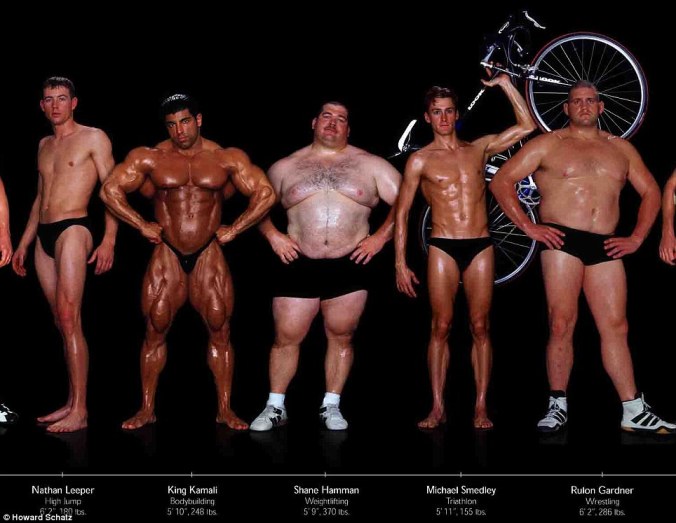
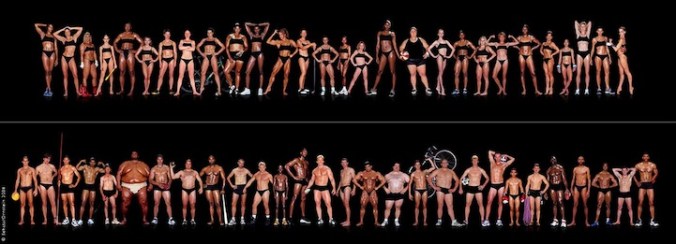
While you may desire to look like the models, it’s important to realize that you don’t need to look like them to be fit and healthy. There are some great pictures on internet that (I believe) were published by Sports Illustrated. They show the bodies of top athletes in different sports. Their body types vary widely, illustrating how you can be very fit, elite in your field, and still have a body that doesn’t look like those fitness models.

male athletes

The idea of being comfortable in a less than Adonis body, means that you are less stressed, less anxiety ridden about your appearance, which should allow you to enjoy life a little more.


1DB53F88-D145-469D-A558-0A778F5C07D4-2580-00000269638C2946The catch is that this doesn’t mean sit around and eat whatever you want. You still have to workout and eat healthfully. That’s what is going to help you get/stay fit (to do whatever it is that you want to do) and healthy by getting all of the nutrients you need for your body to function properly. But, you don’t need to look like a fitness model. Be fit, be healthy, but also be happy in knowing that fitness comes in all shapes and sizes.


Do Our Dietary Needs Change As We Age?

As I was getting ready to replenish my supply of a multi-vitamin/mineral supplement, Centrum Silver for Men caught my eye. This supplement (and the generic versions) are made for the specific needs for men over 50. Hmmn? Being 59, it made me wonder if my nutritional needs had actually changed because of my age. Do we, in fact, need different nutrients because we are older ? older-eating Here are some sources that I looked through for an answer.

According to Eatright.org (The Academy of Nutrition and Dietetics), older men need more calcium and vitamin D (no specific levels stated), as well as more dietary fiber (30g/day).

While the Oregon State University gives specific micronutrient recommendations for adults >50 years old, they don’t indicate any changes from the <50 population.

Finally, the Food and Nutrition Board of the Institute of Medicine, National Academies provides recommended age specific intakes for men and women Dietary Reference Intakes (DRIs): Estimated Average Requirements. Here the only change for men 50-70 is for an increase in Vitamin B6.

So, as for micronutrients go, we might need more calcium, fiber, and vitamins D and B6. Let’s back up a bit and look at the big picture. One of the main nutritional issues for aging adults is malnutrition because as we age we tend to eat less. This may be a result of being less physically active and therefore needing fewer calories or it may simply be a loss of appetite. As you might suspect, a decrease in calories also means a decrease in the nutrients that we take in. The concern is that our health can be compromised if the intake levels of certain nutrients gets too low.

Here are the questions, if we want to keep our micronutrient levels optimal, do we just eat more to get the nutrition we are lacking? or should we take a supplement? if so, does the supplement need to be age specific?

If we are eating less because we are less active, then the decrease in calories is appropriate and to add calories without adding activity would result in gaining fat weight. Of course, I’d like to say, “Get active!” as that would not only allow for a greater caloric intake but also a more functional, self-sufficient life. In lieu of taking in more calories, it seems quite reasonable to take a supplement (check with your doctor first). I take a multi-vitamin/mineral as a “catch-all”, to fill in the gaps just in case I’m not getting the recommended levels. As for the age-specific supplements, I think that if you weren’t eating at all, it might be important. But, as a supplement to your diet (you’re not starting from scratch, after all), I don’t think there’s any real need get that specific.

Back to the original question, do our dietary needs change as we get age? No… and yes. No, there isn’t any significant change in total amounts needed, but yes, as our dietary intake decreases the need to prevent deficiencies becomes greater.

The Final Straw

Many people go through life without feeling the need to exercise or watch what they eat. Weight gain, decreased strength, endurance, and/or flexibility, the onset of disease, these are all situations that happen gradually, many times without the individual’s notice. That is, until something happens that changes their perspective.

This final straw or moment of crisis, shifts an individual’s thinking from, “I’m fine the way I am.” to “I need to do something to change this.” If and when you have this moment, you should write it down in detail. What was going on? What did you hear and see? How did you feel? These are emotional moments and questions that require emotional answers. It is emotions, after all, that drives us. By documenting this, you will help to strengthen your resolve in changing and you will have something to turn to when your motivation wavers.

final-straw

The following are a few of the actual moments that brought clients to me for my help.

“At my last checkup, my doctor told me that I was pre-diabetic and that if I didn’t change how I was living my life, I would need to go on insulin.”

“I fell down outside my barn and I couldn’t get off the ground. It took me three hours to eventually get to something that I could use to help me pull myself up.”

“I saw a picture of myself and I couldn’t believe it was me. How could I have gained so much weight?”

“I just found out that my daughter is pregnant and I want to be around to be part of my grandchild’s life.”

To change our lives takes a change in our mindset, a shift in our priorities. When that final straw moment happens, you need to own it. You can change, and, while not knowing how to can be a problem, it’s no excuse. Find help and always keep in mind why changing is important to you and your life.

Good luck, and let me know if I can be of help. Mark

What’s Really Affordable Care

As I write this, the Affordable Care Act (aka ACA or Obamacare) is being dismantled for who knows what as a replacement. Although I personally think that the ACA was a great, first attempt at finding something better than a health care system that was already too expensive for most Americans, it does have it’s issues. aca-logoBut, you can never know all of the problems until something is actually put in place. In my humble opinion, we should now be focusing on correcting the things that don’t work with the ACA. That said, what I really wanted to talk about was the most affordable care… preventative care.

According to the CDC, 75% of health care costs are on people with chronic conditions. These chronic conditions include heart disease, stroke, cancer, diabetes, arthritis, obesity, and respiratory diseases. Furthermore, the CDC estimates that eliminating these 3 risk factors – poor diet, inactivity, and smoking – would prevent:

  • 80% of heart disease and stroke
  • 80% of type 2 diabetes
  • 40% of cancer.

cover-chronic-care_281731694While I know that the majority of smokers know that smoking is hazardous to their health, I believe that benefits of exercise and eating healthfully are too often thought of as just a way to look better. Many people don’t understand the magnitude of health benefits that also come with them. Managing your diet and physical activity really is a health intervention. See Exercise is Medicine!

Going forward, whatever health care system is developed or put in place, it must promote preventative care or we as a nation will never manage health care costs. Of course, you don’t have to wait for that to happen. Take charge of your heath today.

Without concerted strategic intervention, chronic diseases and their risk factors can be expected to cause more harm—and be more costly to society. We cannot effectively address escalating health care costs without addressing the problem of chronic diseases.” – CDC, The Power of Prevention

EIM Canada_clr


The Problem With New Year Resolutions

The new year is coming up and with that come the new year resolutions that rarely get accomplished. We’ve had enough new years come and go and most of us have experienced that feeling of the unachieved promise we made for the new year. Why do you think resolutions are so hard to keep? I have a few thoughts about it that I’m going to share with you.
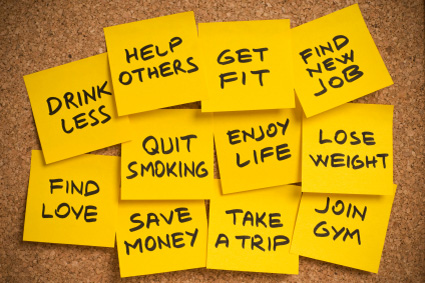
newyearresolutionResolutions rarely come with a plan. They are typically announced (even to ourselves) as a platitude. “This year I will… lose 40lbs, start my own business, quit smoking, spend more quality time with my family, etc.” These are well intentioned statements that, when not accompanied by a detailed plan, can put huge pressure on an individual. They are also highly unlikely to be achieved which leaves us feeling like losers.

Resolutions should also, like any goal, be set using SMART guidelines. SMART stands for Specific, Measurable, Attainable, Realistic, and Time Bound.

Specific is the details of the goal. If your goal is to lose weight, how much and how are you going to accomplish that. I will lose 40lbs by creating an exercise routine that consists of 30min of cardio and 30min of weight lifting three times per week. I will also track my calories using myfitnesspal app and stay within my allotted calorie range.

Measurable, is that specific goal measureable? Well, the more specific it is, the easier it is to measure. Did you workout or not? Did you track your calories or not? Having said that, it may be a better choice to not be black and white about it. Give yourself a percentage ranking for the tasks. I worked out twice this week instead of three. So, I scored 66%. Now, what can you do to get yourself to 100%?

Attainable is a reality check. Is this something you can actually achieve? We can achieve most things, but if I were to say that I wanted to play pro basketball (at age 59), it is highly unlikely that I can make that happen.

Realistic, Well, this has always bugged me a little. It’s really the same idea as Attainable. Is this goal realistic? Honestly, having been born and raised in Maine, I prefer to go with the Maine version. Mainers would pronounce smart “smat” (dropping the r sound) which works just as well as a goal setting guideline.

Time bound is simply putting a deadline on reaching your goals. Without a deadline, it becomes easy to put things off. As the  Parkinson’s law states, “work expands so as to fill the time available for its completion”. The longer you give it, the longer it takes and with no deadline, it will unlikely get done at all.

Our resolutions should also come with a strong and detailed Why. Why is attaining this goal so important to you. Why is this goal important to you? Losing weight is not about looking better or being healthier. It might be about feeling more self confidence when you feel you look better or it may be about being healthier so that you will live long enough to see your grandchildren grow up. Write dow the real, deeper reason why your goal is important.

To top off our chances of success, we should have someone that we are accountable to. Maybe you ask a friend or family member to help keep you on task. Check in as often as you need, but set a regular schedule. Every day at 8pm, or every Monday at 7am. You could even set a time that you check in with yourself. The key is to set a time to objectively evaluate how you are doing.

So, if you want to win at the resolution game, be SMART, know your why, and be accountable for your meeting your steps toward your goal.
Keeping Your Brain Fit

As we age, there are changes that occur that we typically expect to face. These might include some hearing loss, impaired vision, and general aches and pains. These are annoyances for the most part and not things that need to diminish our quality of life to any great extent. However, for many, a big fear and source of anxiety is the possibility of suffering from Alzheimer’s or some other form of dementia. Alzheimer’s is the sixth leading cause of death in the US and the second most feared (after cancer). Who could blame fearing it? It can rob us of our memory to the extent that we don’t remember our loved ones, and, to date, there is no cure for it. That said, there are things we can do to keep our brains as healthy as possible for as long as possible. Brain fitness programs have been explored to help people maintain healthy brain tissue and function.
fit_brainThere are five main elements that we can engage in to help our brains working optimally.
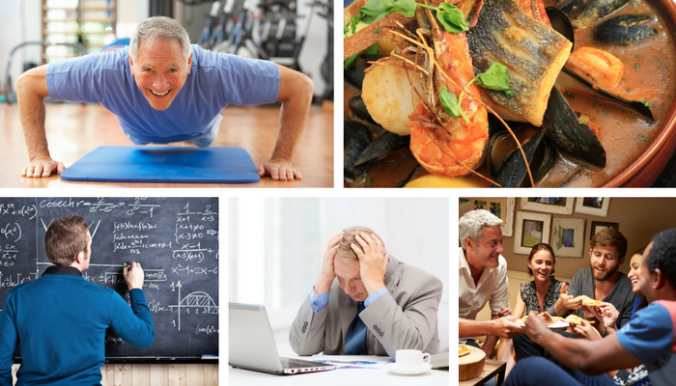
  1. Physical exercise has been shown to improve blood flow to the brain, as well as stimulate the production of brain derived neurotropic factor (BDNF) which has been described as “Miracle Grow for the brain”.
  2. Proper nutrition, healthy foods in healthy amounts (especially those high in omega 3 and antioxidants) helps to keep the brain’s tissues functioning optimally.brainfitness-elements
  3. Cognitive challenge is essential and more than just doing crossword puzzles and Sudoku. Look for learning opportunities that involve multiple senses such as learning to play an instrument or learning to speak another language.
  4. Stress management can have a big effect on our lives. Stress elevates cortisol levels (stress hormone) which, if it is chronic, can destroy brain cells making it harder to remember and think clearly. Try activities that can reduce stress such as exercise, meditation, or other things that draw your attention away from your stressors.
  5. Socialization is also important. Studies have shown that people with many social connections, that they interact with on a regular basis, experience a slower rate of memory decline.

These elements of a brain fitness program don’t need to be addressed separately. In fact, one of the best things you can do is to layer various elements together. Fitness classes are a great example of the possible layering, exercise, cognitive (following and/or learning choreography), stress reduction, and socialization with others in the class. Another example could be taking an Italian cooking class where you also learn Italian (cognitive, socialization, possibly nutrition). As I think about it, there’s a very popular one at the moment, the social painting classes (socialization, cognitive, stress reduction).

We can make a difference in our brain’s health and function. The mind is a terrible thing to waste. (I think I heard that someplace 🙂 ) Don’t let yourself slide into mental decline if it can be prevented or even delayed. Try to integrate these 5 elements into your life. Mix and match them. They are what make life richer and help keep it that way.


Eating to Build Muscle

Building muscle, whether young or old, keeps us able to do the things we want in life. That may be playing sports or carrying groceries. It also, being a more metabolically active tissue than fat, helps us keep fat off. The more muscle we have, the higher our resting metabolism, which means we burn more calories at rest than someone with less muscle. Now, to build muscle, we need to challenge them so they need to adapt and grow. This is most effectively done through resistance training (i.e. weight lifting). Most of us understand that. What a lot of people don’t know is that eating the right foods in the right portions is equally important.

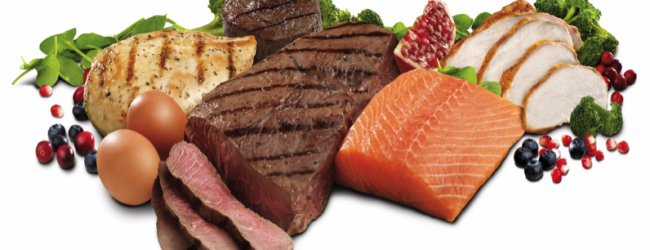
Let’s start where everyone’s mind goes first, protein. Protein, by itself, does not build muscle! Resistance training stimulates muscle growth. However, if you don’t have adequate protein to help with tissue synthesis and repair you will not gain muscle and will likely even lose it.

natural-protein-650x250

So, how much protein do we need? Often, the RDA (recommended daily allowance) is looked at for guidance. You would think that would make sense, right. But, the RDA is about surviving, not thriving. They are minimal allowances. To build muscle, we need more. Alan Aragon, nutrition researcher and educator, in his book with co-author Lou Schuler, The Lean Muscle Diet, recommends 1 gram of protein per pound of Target Body Weight (TBW). So, say you weigh 240 pounds and wish to weigh 200, 200 lbs is your TBW. That means that you should eat 200 grams of protein per day. This is equivalent to 2.2 grams per kilogram, almost 3x the RDA which only recommends 0.8 grams per kilogram. Now, Aragon is not being age specific with his proposal. Yet, several studies that looked specifically at older adults, recommend increased protein intake from 0.8 to between 1.2-1.5 grams per kilogram, still less than Aragon’s. I believe (yes, this is me giving you a judgement call) that, from all of the research I have read and presentations that I have been to, the amount of protein for muscle gain (thriving, not surviving) lies on the higher end of the spectrum, probably between 1.8 and 2.2 grams per kilogram.

Now, muscle-building nutrition is also more than just about protein. We need adequate carbohydrates and healthy fats AND … enough total calories. If we are eating too few calories our bodies may turn to our muscle to break down into fuel. Obviously this is counter productive if we are trying to gain muscle. I’ve worked with many, so-called, hard gainers (those that can’t seem to gain muscle). More often their difficulty stems from one of two things or a combination of both. Either they are not challenging themselves appropriately with their weight lifting program or they are not eating enough to support muscle growth.

Quick approximation of Daily Caloric Needs (DCN): there are many formulas to determine DCN and all are ballpark guesses. I tend to start with the Harris-Benedict equation to determine the resting or basal metabolic rate (BMR) add in activity level and thermogenic effect of  food. Then I will tweak it up or down as we monitor results. You can use this link to get you started – Harris-Benedict calculator. Take your BMR number and multiply it by your activity level (1.2 for couch potato – 1.75 for high-end athlete). Now add in 10% of your BMR for the thermogenic effect of  food. This will give you an approximation of your DCN.

If you want to gain muscle at any age you need the growth stimulus (resistance training) and the support for growth by getting enough protein and total calories. Now go put on some muscle!

Day 1: Taking Stock

Before we know what we need to change, we need to know what we are doing. Unlike going on the new popular diet, a lifelong solution to health and fitness is finding changes that we can sustain. It’s about tweaking what we are currently doing until it meets our needs. So, how far off that mark are we?untitled-design-12

From a dietary standpoint that means we need to do a diet diary. Many people like to use the app myfitnesspal (myself included). Lose It is another highly rated diet tracker. For three days simply enter what you eat and don’t worry about any particular goals. We’re just trying to see where we stand at this point. From there we can look at our calories and macronutrients and make changes as needed. (I’ll get into more nutritional specifics in a later post.)

As for exercise, we want to measure not just what we do (or don’t do) in the gym, but also how much we move around all day. While there are some great tracking devices like Garmin Vivosmart HR+ ($219.99) and Fitbit Charge 2 ($149.95), they can out of the price range for many people. LifeHacker recommends the free smartphone app Moves for tracking walking, running, cycling as well as mapping your route. If you don’t have a smartphone and don’t want to spend the money for the high-tech options, you can pick up a simple pedometer such as the highly rated Ozeri 4x3sport Tri-Mode Activity Tracker ($19.45). Once we evaluate our current activity level, we have established a level to improve upon.

Now, of course there are many more elements that we could measure and establish as a baseline, such as weight, body composition, cardiovascular endurance, strength, flexibility, etc. These are great to have, but sometimes finding the qualified individual to take you through these assessments can slow you down and act as a barrier to getting started. The diet and activity levels can be easily done on our own.

Remember that we can’t map our journey toward reaching our goals if we have no idea where we are starting. Establish your starting point and from there you can chart your progress.